
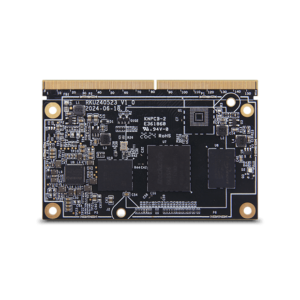
A system on module(SoM) is a complete computing solution integrated onto a small, compact board. It combines essential components such as the processor, memory, storage, and input/output interfaces into a single module, allowing for simplified system design and faster product development. SoMs are widely used in embedded systems, industrial automation, IoT devices, and robotics due to their versatility and efficiency.
One of the primary advantages of a system on module is its ability to reduce development time. By providing a pre-integrated platform, developers can focus on application-specific software and hardware customization rather than designing the entire system from scratch. This not only accelerates time-to-market but also reduces development costs.
SoMs are designed for scalability and flexibility. They support various processors, from energy-efficient ARM cores to high-performance multicore CPUs, enabling applications that range from lightweight IoT sensors to complex AI-enabled devices. The modular design also allows for easy upgrades, as developers can swap or upgrade the module without redesigning the entire system.
Another key benefit is compactness. System on modules provide high performance in a small footprint, making them ideal for space-constrained environments. They often include integrated connectivity options, such as Ethernet, Wi-Fi, or Bluetooth, enabling seamless communication between devices.
In conclusion, system on modules provide a powerful, efficient, and flexible solution for modern embedded computing needs. Their compact design, scalability, and ease of integration make them essential for developers looking to implement advanced computing capabilities quickly and reliably across a wide range of applications.
OSM Module: Streamlining Embedded System Design
An osm module, or Open System Module, is a compact and integrated computing solution designed to simplify the development of embedded systems. It combines essential components such as processors, memory, storage, and input/output interfaces into a single module, providing a ready-to-use platform for developers. This integration allows for faster deployment of applications in areas like industrial automation, IoT devices, robotics, and smart electronics.
One of the main advantages of an OSM module is its efficiency in reducing development time. Developers can focus on building software and application-specific features without the need to design the underlying hardware. This modular approach also lowers production costs and speeds up time-to-market for new products.
OSM modules offer scalability and flexibility, supporting various processor types, from low-power cores for lightweight applications to high-performance multicore CPUs for complex tasks. They often include connectivity options such as Wi-Fi, Bluetooth, and Ethernet, enabling seamless integration into larger systems or networks.
Compact design is another key benefit of OSM modules. Their small footprint makes them suitable for space-constrained environments, while their integrated architecture ensures reliable performance and simplified system maintenance. Additionally, upgrading or replacing modules is straightforward, allowing systems to evolve without complete redesigns.
i.MX93: Advanced Processing for Embedded Applications
The imx93 processor is a high-performance solution designed to power modern embedded systems. Built with energy efficiency and versatility in mind, it delivers reliable computing performance for a wide range of applications, including industrial automation, smart devices, IoT solutions, and advanced human-machine interfaces.
One of the key strengths of the i.MX93 processor is its combination of high-performance processing and low power consumption. Its architecture is optimized for running complex applications, including AI inference, real-time data processing, and multimedia tasks, while minimizing energy usage. This balance makes it ideal for devices that require continuous operation without compromising efficiency.
The i.MX93 supports multiple connectivity options, enabling seamless integration into networks and smart systems. It is compatible with standard communication protocols and interfaces, allowing developers to implement robust and flexible solutions across various environments.
Another advantage of the i.MX93 processor is its scalability. Developers can utilize its processing capabilities for lightweight edge applications or more demanding workloads, thanks to its multicore architecture and optimized memory management. This flexibility allows for rapid deployment and customization in diverse embedded projects.
In addition, the i.MX93 is designed to simplify development and reduce time-to-market. With a wide range of supported software frameworks and development tools, engineers can focus on creating innovative applications rather than building the underlying platform from scratch.
In summary, the i.MX93 processor offers a powerful, energy-efficient, and flexible solution for embedded systems. Its combination of high performance, low power consumption, and broad connectivity options makes it an ideal choice for developers seeking to implement intelligent, reliable, and scalable solutions in modern devices.